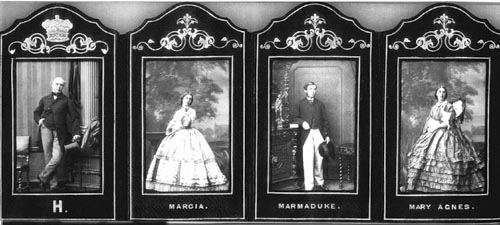
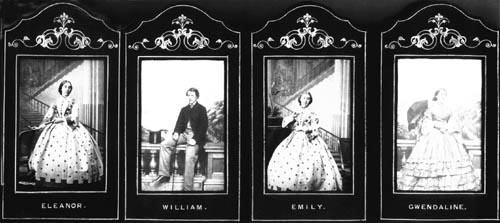
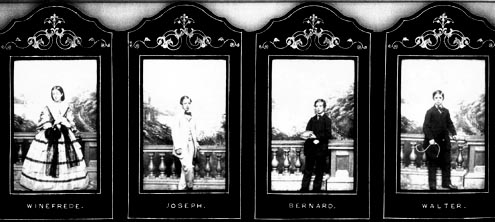
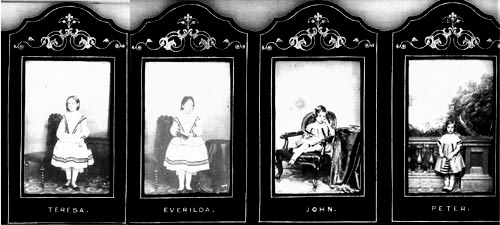
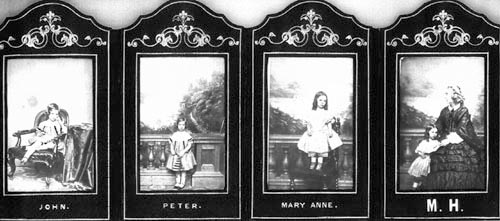
William Haggerston-Constable
of Everingham
When William Maxwell of Nithsdale died in 1777 he left but
a single daughter, Winifred. She then became his sole heir and by
definition his heir-general. Her inheritance was her grandfather's
vast estates of the Earldom of Nithsdale which she placed into the
hands of her husband William Haggerston-Constable of Everingham Hall
in Yorkshire.. He took the additional name of Maxwell and between
them, they gave rise to the vast army of Constable-Maxwells, Constable-Maxwell
Stuarts and Constable-Maxwell Scotts that abound today.
The grandson of Winifred, William Constable-Maxwell claimed the title
of Lord Herries in 1848 by proving that the title had come to the
Maxwell family from the Herries family through right of inheritance
of heirs-general although the evidence appears that Mary, Queen of
Scots, made Sir John Maxwell of Terragles, Lord Herries as a new creation
in 1567. William Maxwell of Carruchan, the then heir-male, contested
the claim but lost the case in the House of Lords. The title of Lord
Herries has subsequently passed to the family of the Duke of Norfolk
as William, Lord Herries' granddaughter who was heir-general to the
title, married into that family.
Introduction to 'The Dormant Earldom of Nithsdale' by W. Harold Maxwell
(c.1890)
Further reading
There is an interesting website devoted to: Maxwell of Carlaverock,
Maxwell of Cavens, Maxwell of Gribton, Maxwell of Kirkhouse, Maxwell
of Nithsdale, Maxwell Herries of Terregles. Click here:
http://www.stirnet.com/HTML/genie/british/mm4ae/maxwell02.htm#top
Andrew Constable Maxwell
Andrew was David's nearest brother and Hon Bernard Constable Maxwell's
5th son. He had a distinguished war and wrote the following tale which
is published in Lord Lovat's memoir 'March Past' (Wiedenfeld and Nicholson,
1978)
THE SPIRIT OF THE REGIMENT
By Andrew Constable Maxwell, MC, Scots Guards
War experiences can be boring unless they are your
own; then they are fascinating!
The 2nd Battalion Scots Guards, with whom I was serving
as a newly arrived junior officer, was strung out behind Rigel Ridge,
not far from Tobruk, in an area called ‘Knightsbridge’
– a misnomer and not to be confused with London, SW. Our task,
during those mid-June days of 1942, was to engage and hold up an enemy
attack during a critical period while the Knightsbridge ‘box’
was being evacuated.
On 11 June, we were most heavily shelled throughout
the morning. It did not sound too bad because the sequence of bangs
was reversed. First, the crack as the 88 mm shell – hopefully
– went over us. Secondly, the explosion as it hit the ground,
and only thirdly - the noise from the gun. This was heartening as
it gave the impression that these were our shells going towards the
enemy! During lunch I was punctured by shrapnel – which brought
my morale back to normal. It was only a small fragment and in the
back, but no conclusions should be drawn from this. A medical orderly
bound it with the army equivalent of Scotch Tape and the only real
casualty was my shirt, and I did not retire hurt as the company commander
had been killed and his second-in-command was also a casualty.
Unfortunately a telegram went out which caused my family
some concern. Two days after this, on 13 June, at about mid-day, a
highly alarmed forward observation gunner came hurrying through our
line in his armoured car and informed us in the briefest possible
terms that a heavy enemy tank force was approaching.
We had adjusted ourselves to this new situation and
before long a great number of ponderous grey tanks came into view
on our exposed flank. Our anti-tank gun hit a few before being put
out of action. It must have been rather frightening for them, as they
were bound to be demolished within a few moments of firing their first
shot. During the heavy shelling which accompanied all this action,
I was impressed by the nonchalance of the desert larks, which flew
around in full song, showing no slightest sign of alarm. The other
incongruous sound came from our portable gramophone, which kept repeating
a currently popular (desert) song called ‘Sand in my Shoe’.
All too soon I heard a grinding sound in front of me and over the
ridge came the largest tank I had ever seen – no doubt the same
size as all the others, but it looked impressive against the sky at
about thirty yards’ range. The monster had a look of confidence,
power and majesty, and in a fleeting way reminded me of Queen Victoria.
It also presented a wonderful camera shot and I reached for the Minox
camera which I always – improperly – kept in the breast
pocket of my shirt. It was not there and I remembered that when I
had last changed the old blood-soaked garment, I had forgotten the
Minox – a piece of very bad luck. All unrecorded, the tank lumbered
through our position and two hundred yards behind us slowly turned
round with grunts and groans to face our rear.
Its gun ended pointing straight at my pick-up truck
– understandably, I suppose, because it had an antenna sticking
out of its roof and was obviously the company command vehicle. At
this late stage, all my modest military training came to my aid and
it seemed imperative that I send word back to battalion HQ that our
company had been over-run. Causing as little commotion as possible,
I crept to the pick-up and managed to get the switch on and pull out
the headphones. Then I snaked under the truck and made contact with
HQ. Thoughtlessly, I passed a message, ‘Enemy tanks have over-run
our position and I have surrendered.’ This seemed a perfectly
straightforward and informative message, until I remembered with a
shock that officers and men of the Brigade of Guards never surrender.
At considerable risk I had to return to the truck and go through the
whole process again to cancel the last message and replace it by ‘Enemy
tanks have penetrated our position and we are pinned down and surrounded’!
The joke being that when I later asked battalion HQ what had been
the reaction to my signals, I was told that nobody had any recollection
of receiving any message at all.
But to return to the battle. In a few moments worse
was to come. The whole area was suddenly full of German infantry.
They looked small and purposeful but quite unlike a war image on the
silver screen.
There is a moment of euphoria when one realizes that
one is still alive but that one’s war is over. I found it interesting
that during a period of action, when risks are high and confusion
great, one’s various senses become saturated with unaccustomed
noises and, particularly, smells – maybe some of them are human
fear smells. Certainly feelings are dull in some areas and acute in
others. For instance, one discovers all sorts of abrasions, bruises
and cuts on elbows and knees, but has no recollection of when these
occurred.
The euphoria did not last and while I still had the
chance I stowed my oil compass under my hat. It is hopeless trying
to move long distances in the desert without a compass, especially
at night.
I thought this an appropriate moment to send a final
message to HQ, but was dissuaded by the new arrivals, although I pointed
out that this was ‘for information only’.
There were some packages of cigarettes lying about on
the ground and a German NCO indicated that I could pick them up if
I wanted them. This was nearly a sad accident. As I bent down, the
heavy compass jumped forward and nearly took my hat off. Fortunately,
the strange movement in my cap went unnoticed.
We were herded together and, as some of the men were
walking wounded and, inevitably, thirsty, I stopped a great eight-wheeled
armoured car and asked for some water. The German officer handed me
a jerry-can full of liquid and told me not to use more than necessary,
as this was part of his crew’s ration. I observed this strictly
and as we parted he gave me a very guards-like salute, which I returned
with all the parade-ground skill I could muster.
As it got dark a loud, most ugly-sounding voice called
all prisoners to line up. This imminent loss of liberty had a profound,
if belated, effect on me – also on my brother officer, Ian Calvocoressi,
and we immediately called a conference on the subject of escaping
before it was too late. We could not agree on the bearing to follow,
so we decided to go our own ways independently. We each took a deep
breath – at least, I suppose Ian did – and ran like the
devil out into the dark. The last word I heard was a shout from Ian.
Later he told me that I was running directly at a sentry. He seemed
to see better in the dark than me. His warning proved to be right
when at full speed I passed within a few feet of one of the surrounding
guards. He took no action whatever and I can only suppose that he
had had a wearing day and did not want to start anything. After running
about two hundred yards without any lights going up or alarm given,
I knew I was out of trouble, and this was the most exhilarating moment
I had in the war.
Later that night, as I was passing back through our
old position, I saw a crouching figure moving in somewhat the same
direction as me. He was small and looked like Ian, but, having got
so far, I did not want to take even the slightest risk, so we did
not make contact until the following day at our battalion HQ. With
my oil compass, I felt very secure. It was rather a long walk, nine
hours in all, because I decided not to take a short cut by going through
our minefield, but round it. They were all anti-tank mines, so could
not be detonated by the weight of a body. But you can never tell,
can you?
Days like this made you thirsty. At one point during
the night I passed some old earth-works where there had been earlier
fighting. In the hope that I might find an abandoned water container,
I went into a deep dug-out, but suddenly I had such a strong feeling
of people all around me, and the atmosphere was so spooky, that I
resisted the need for drink and kept going.
The next surprise was to see a light in the distance.
I thought of every possible solution to account for it, and eventually,
out of curiosity, crept up and found the source was the luminous dashboard
of a crashed aircraft. In due course I got back to the battalion and
was greeted by ‘Why the hell did you take so long?’ At
least I made it several hours before Ian, which proved my superior
desert craft! Ian later had a good story that during the night he
had seen a crouching figure moving and peering in all directions,
which he rightly took to be me. He was able and willing to demonstrate
my action in a way which was considered humorous to anybody who cared
to watch!
Footnote - in October
2006 Kit Constable Maxwell (nephew) and friends visited the North
African desert to follow the route of the LRDG raid on Fort Murzuq.
The 1940 raid was led by Major Clayton with Capt Michael Crichton-Stuart,
Scots Guards. This expedition was the subject of Kit's lecture at
the Victory Services Club, April 2007.
Extract from 'The Everingham Papers' lodged
at Hull University
The last residents of Everingham Park were Jennifer (née
Constable Maxwell) and her husband Christopher Newton in the 1970's.
The owner Anne Herries, daughter of Bernard, 16th Duke of Norfolk,
has now sold the house.
In 1756 William Haggerston Constable commissioned John
Carr of York to build Everingham Park on the site of the Elizabethan
house of the Constables. He also united the families of Constable
and Maxwell by marrying Lady Winifred Maxwell and their heirs became
the Constable Maxwell family of Everingham with estates in Scotland
belonging to the earls of Nithsdale and barons Herries.
Winifred Maxwell could trace her history back to Undwin and his son
Maccus in the eleventh century; Maccus gave his name to the barony
of Maccuswell, or Maxwell. His grandson, John de Maccuswell (d.1241),
was first Lord Maxwell of Caerlaverock.
The baronies of Maxwell and Caerlaverock then passed down through
the male line, sometimes collaterally. Robert de Maxwell of Maxwell,
Caerlaverock and Mearns (d.1409) rebuilt Caerlaverock castle and was
succeeded by Herbert Maxwell of Caerlaverock (d.1420) who married
Katherine Stewart.
Their son, also Herbert Maxwell (d.1454) married a daughter of Herbert
Herries of Terregles. He was created Lord Maxwell and this title passed
down through the male line. John, 4th Lord Maxwell, was killed at
Flodden in 1513 and his son, Robert, 5th Lord Maxwell (d.1546) was
warden of the western marches and his commission by James V as master
of the royal household is in the collection. His eldest son, Robert
became 6th Lord Maxwell (d.1552) and his second son, John Maxwell
(d.1582), married Agnes Herries, sole heiress and eldest daughter
of William, 3rd Lord Herries and he became 4th Lord Herries of Terregles.
Both sides of the family were Catholic. Robert, 10th Lord Maxwell
raised troops for Charles I through the 1620s and was created 1st
Earl of Nithsdale. He was on the Scottish privy council and became
an anti-Covenanter. He died in 1646, leaving behind one son, Robert,
11th Lord Maxwell and 2nd earl of Nithsdale, who negotiated with General
Monck and Charles II. He died without ever marrying in 1667 to be
succeeded by John Maxwell, 7th Lord Herries when co-lateral lines
of the family rejoined.
John Maxwell, became 12th Lord Maxwell, 7th Lord Herries and 3rd earl
of Nithsdale. His grandson, William Maxwell, 14th Lord Maxwell, 9th
Lord Herries and 5th earl of Nithsdale (1676-1744) was a Jacobite
whose wife dressed him in women's clothes to effect his escape from
prison. They fled to the continent and spent the rest of their lives
in exile. Lady Winifred Maxwell's account of her husband's escape
is in the collection at Hull Library.
Their grand-daughter, Winifred Maxwell, married William Haggerston
Constable and he assumed the name of Maxwell. Their son, Marmaduke
Constable Maxwell (1760-1819) divided the Scottish estates between
his sons. William Constable Maxwell (1804-1876) became 10th Lord Herries
and was responsible for building the Italianate Catholic chapel next
to the house at Everingham.
His brother Marmaduke Constable Maxwell was a Tory patron and builder
of a Catholic chapel at Dumfries. Marmaduke Constable Maxwell, 11th
Lord Herries (1837-1908) married Angela Mary Charlotte Fitzalan Howard
who was the daughter of Edward George Fitzalan Howard, 1st Baron Howard
of Glossop and 2nd son of the 13th duke of Norfolk (1818-1883). His
brother, William Constable Maxwell (1841-1903) was responsible for
having The book of Carlaverock privately printed and a copy of this
rare item is in the collection.
Marmaduke and Angela Constable Maxwell had only one daughter, Gwendolen
Mary, who inherited from her father the Herries title and nearly 20,000
acres of land evenly split between her English estates in the East
Riding and Lincolnshire and her Dumfries Shire estates in Scotland
which included Caerlaverock castle. She became the second wife of
Henry Howard, 15th duke of Norfolk in 1904. Their son, Bernard Marmaduke
Howard (1908-1975) became 16th duke of Norfolk.
When she died in 1947 he also became Lord Herries. He was minister
of agriculture between 1941 and 1945 and married Lavinia Mary Strutt.
They only had daughters and the duchy passed to Miles Frances Stapleton
Fitzalan Howard, son of Bernard Edward 3rd Lord Howard of Glossop
and Mona Joseph Tempest Stapleton of Broughton Hall and Carlton Towers
(see Beaumont family).
Major Gerald C Maxwell.
From “Air Stories”
July 1939. volume 9. number 1
Article entitled – THIS FIGHTER WON FAME
Flight-Commander in the Famous 56 Squadron and Fighting Companion
of Albert Ball, Major Gerald C Maxwell Scored 27 Victories in the
War in the Air, and survived one of the most amazing crashes in the
history of his Squadron.
By A.H. Pritchard.
Some months ago the biography of Captain A.P.F. Rhys-Davids appeared
in this magazine and among the letters of appreciation received by
the writer was one from a former squadron-mate of Rhys-Davids, Major
Gerald C Maxwell, M.C., D.F.C., A.F.C. By a curious coincidence, the
writer received in the same post several requests for Major Maxwell’s
biography, but, lacking sufficient reliable information, was not then
able to accede to them. Now, thanks, to the kind co-operation of Major
Maxwell himself, who loaned the writer his diaries and log-book, it
is possible to recount the true story of this distinguished air fighter
who is officially credited with the destruction of twenty-seven enemy
aircraft.
Born at Fairlie House, Inverness, on September 8th 1895,
Maxwell came from a family of famous soldiers, his Uncle, Lord Lovat,
having formed the yeomanry???
Company which bore his name during the Boer War. When the Great War
came, Maxwell, as was to be expected, left his studies at Cambridge
and took a commission in the Lovat Scouts, in which company he added
fresh glory to the family name at Suvla Bay, Galipoli, when, with
all his superior officers put out of action, he took command with
outstanding success.
After a tour of duty in Egypt, he returned home, and,
on September 20th, 1916 transferred to the Royal Flying Corps, where
he startled his instructors by going “solo” after only
twelve minutes of “dual” instruction. Advance training
on Moranes, at the Central Flying School, Upavon, followed, and on
March 12th, 1917, he went to London Colney, where the soon-to-be famous
56 Squadron was preparing its S.E.5’s for the great arena.
Orders for France were received on April 6th, and at
11am on the following day the Squadron began its flight to St. Omer
and, once there, the pilots had practically to rebuild their machines.
In its factory form, the S.E.5 had a large celluloid cover over the
cockpit (one of to-day’s “new” ideas), but these
restricted vision and so were soon removed. The Lewis gun on the top
plane was also badly fitted and could only be fired upwards, so this,
too, was “tinkered” with and raised about 2.5 inches to
enable it to fire over the propeller top, its fire then converging
with that of the Vickers about 50 yards in front of the machine’s
nose.
By the 22nd of April the machines were ready, and Maxwell
had the honour of accompanying Captain Albert Ball on the first flight
up to the lines, but, as strict orders had been issued that no S.E.5
was to cross, it was not until the 24th that he made his first offensive
patrol.
During the early afternoon, Ball led “A”
flight in a patrol between Douai and Cambrai, and, soon after crossing
the lines, Maxwell and Second Lieutenant C.R.W. Knight dived on an
Albatros Scout. Knight overshot, but Maxwell came down to within ten
yards of the German’s tail and opened fire with both guns. The
Albatros began to spin and eventually crashed near Hamel, and Maxwell
had made a brilliant start to his distinguished career.
Four days later, he had a miraculous escape from death
during a fight with several Albatros Scouts over Fontaine. Here is
the account as given in the Squadron History: “At about 12,000
feet Maxwell had been hit by Archie in the engine and elevator control
and began to glide back with practically no elevator control over
his S.E.5. He hit the ground at about 140 m.p.h. near Combles, where
it was covered with trenches and shell-holes. The whole front of the
machine, including the engine, broke off. The rest of the aeroplane,
with Maxwell in it, bounced along for nearly a hundred yards and was
smashed to pieces. Maxwell emerged quite uninjured”
On May 5th, Maxwell, Knaggs and Ball were patrolling
the Arras-Cambrai road when they sighted eight Albatros Scouts over
Reincourt, and the three S.E.5’s immediately climbed above the
German formation. Maxwell flew so close to his chosen opponent that
he actually saw the pilot’s body jerk and fall forward as the
bullets entered it, and the Albatros hurtled down into Sauchy-Lestree.
In the meantime, Ball had downed a two-seater, and as both Knaggs
and Maxwell had trouble with their guns, the trio landed on the aerodrome
of No. 23 Squadron at Baizeux. Ball and Maxwell took-off again and
were about to dive on a pair of two-seaters when they were attacked
by four red Albatros Scouts from Richthofen’s Staffel. More
enemy machines also came up, but despite the fact that both had gun
stoppages, Ball and Maxwell managed to extricate themselves from a
very tight corner and return home slightly shot up, but otherwise
unhurt.
The Menace of the Gothas
When Ball was killed on the 7th, Maxwell was appointed temporary Flight
Commander, and on the 11th he celebrated his promotion by shooting
the wings off an Albatros near Pont-a-Verdin, and another over Lens
on the following morning. Captain Prothero relieved him on the 14th,
and five days later he returned home to enjoy a well-earned leave.
Returning to France on June 4th, in time for the battle
of Messines, he shot down an Albatros two-seater on the 15th for his
fifth victory, but did not score again until late in July, for 56
Squadron was recalled to England to combat the Gotha menace and Maxwell
enjoyed another fortnight in England.
Back again in France, the Squadron found that the enemy
scouts were becoming even more numerous, and on July 20th a large
formation of Albatros were encountered between Houthulst Forest and
Roulers, two of which fell to Maxwell’s guns.
Six days later “A” Flight had to mourn the
loss of its leader, Captain P.B. Prothero, who had his wings shot
off by an Albatros. During the same flight Maxwell destroyed a Rumpler
two-seater, and on the following day was appointed to the vacant command.
August brought him victory after victory, two scouts over Menin on
the 18th, two more on the 21st, and another on the following day bringing
his score up to fourteen.
September saw an improvement in the weather, and the
enemy were in the air from dawn to dusk especially around Houthulst
Forest, where Maxwell and R.T.C. Hoidge each accounted for an Albatros
on the 11th. On the 16th. “A” Flight were on escort duty
to a bomber squadron, and had reached Hoogledge when the inevitable
scouts appeared. Within a few seconds these were joined by a formation
of fast two-seaters and the fun waged fast and furious. The S.E.5’s,
however, put up a stiff resistance, and the Germans eventually drew
off minus two of their number, a scout having been destroyed by Hoidge
and a two-seater by Maxwell. The bombers reached their objective and
returned without loss.
Maxwell’s victories continued to mount. Another
two-seater went crashing to earth behind its own lines on the 20th,
still another fell in flames on the next day, a Pfalz fell, near Staden
, on the 28th, and on the 30th he scored a particularly memorable
victory. At dawn on that day the Squadron’s bag had reached
198 and there was keen rivalry between the flights to gain the coveted
200. “B” Flight failed to sight any E.A. in this patrol
and late in the day Maxwell led his men out to try their luck. It
was with considerable elation that they piled into an unwary Albatros
formation over Comines, and they reached the “double century”
through Lieutenant R.A. Mayberry, who bagged No. 199, and Maxwell,
who made it the round figure by shooting the wings of a green and
silver machine.
Air Fighting Instruction
On October 21st. Maxwell was called home and placed in command of
instruction at the School of Aerial Fighting, Turnberry, where he
served with remarkable success until he managed to persuade his superiors
that he required a “refresher course” in France. After
much sorting of red tape he was eventually “released”
in mid-June, 1918, and allowed to return to the Front for five weeks.
He soon showed that he had lost none of his old skill
and daring during his absence, for, during the course of his second
patrol on June 16th he attacked a trio of two-seaters and crashed
one near Hamlincourt. The remaining two hurriedly made off, but Maxwell
had not yet finished with them, and catching them up, he downed another
on the outskirts of Wavcourt. The 27th. found him in the thick of
a dogfight over Peronne, during which he shot down a Fokker Triplane,
and on the following day, during a distant offensive patrol over Dompiere,
the Squadron destroyed four scouts, one, an Albatros, giving Maxwell
his 25th victory.
On the first day of the new month Maxwell went out with
Captain C.M. Crowe, and, north-east of Albert, they met a formation
of the much-advertised Fokker D.7’s. These crack machines held
no terrors for men of their experience, however, and they both returned
home with another scalp to add to their collections.
During the afternoon of July 5th, Maxwell was notified
that he must return to England, and an hour after receiving the message
he took-off for a last fling at the enemy. Hostile aircraft were conspicuous
by their absence and Maxwell had to fly as far as Dompiere before
a chance presented itself. A Fokker d.7 was climbing through a low
cloud when the S.E.5 came down like a thunderbolt, and before the
unfortunate German could recover his scattered wits, his machine began
to break up around him.
Flying in the U.S.A.
After the Armistice, Maxwell went to America in March 1919, to take
part in the advertising of the great Victory War Loan, and some of
the machines he had to fly were more dangerous than the bullets of
the German war-birds had been. With a motley collection of old S.E.5’s,
D.H.4’s, D.H.9’s, and surrendered Fokker D.7’s he
and his men gave exhibitions throughout every State in the Union,
and no doubt, enjoyed themselves immensely. Returning once more to
England, he joined the Staff of the Air Ministry, where he remained
until his retirement from the Service.
To-day, as a respected member of the Stock Exchange,
he copes as successfully with Bulls and Bears as he once did with
temperamental Hissos or the mechanisms of Vickers guns, but the years
have treated him lightly and, no doubt, he will be ready to be “up
and doing”, should war once again reach into the skies above
England.
--------------------------------------------------------------------------------------------------
BOSWORTH HALL at Husbands Bosworth
By Susan Turville-Constable Maxwell
The impressive stately home of Bosworth Hall actually comprises two houses, the Old Hall, and the 'new' Georgian Hall, together with various Victorian additions and sits in parkland on the eastern edge of the village.
Since 1632 it has been the home of the following families: Fortescue (1632 1763) Fortescue-Turville (1763-1900) Turville-Petre (1907-1945) Turville-Constable Maxwell (1945 to present day) all of them Roman Catholic.
As first recorded, the Old Hall was owned by the de Stoke family (from about 1293-1537) and by the Smiths, amongst others, until 1632. Erasmus Smith was certainly living there from 1570-1616 and is noted as being particularly wealthy. It therefore seems likely that he carried out many of the Elizabethan alterations.
The structure of the original Norman building which the Smiths inhabited, was supported by wooden 'crucks' (a wooden scaffold set into the ground providing support to walls and roof), one of which can still be seen in the cupboard off the main entrance hall. The fireplace of this early building can still be seen in the cupboard in the passage leading from the sun-room to the hall. The position of this fireplace shows that the original house would have extended westwards, towards the church.
Further evidence of the old Norman house can be seen in the wattle and daub around in the cupboard in the panelled landing room on the first floor. There are other features still visible, like some original Elizabethan stained-glass windows in the upstairs rooms and downstairs small sitting room, next to sun-room. These show the Coats of Arms of England, Scotland and Ireland, along with some family arms particularly those of the Smith family.
After the demise of the Smith family, Bosworth was bought by Lady Grace Fortescue, (née Manners of Hardwick Hall), widow of Sir Francis Fortescue of Salden, in Buckinghamshire, who came to live at Bosworth with her son, William. She was a recusant, and refused to join the new Church of England faith. Thus began the long line of Catholic inhabitants.
The Fortescues had refused to support Henry VIII when he abolished the Church of England. This he was famously forced to do after being excommunicated by the Pope for divorcing his first wife Catherine of Aragon. Henry VIII inflicted severe penalties on those who refused to convert, and it was a dangerous time for Roman Catholics. Fines were imposed on those who refused to take the oath and the death sentence was carried out on many occasions. These included two of Robert Turville-Constable Maxwell's ancestors, Sir Thomas Moore and Sir (Blessed) Adrian Fortescue who were executed for refusing to support Henry's church.
In one 10-year period around this time, 252 Jesuit priests had entered England from France and more than half of them were captured and executed. The Fortescues continued to celebrate Mass in secret in the drawing room - still known as the chapel room - and on one occasion an urgent message came to warn the priest that a raiding party of soldiers was on the way. In his haste to clear away the evidence of the service and escape, he upset the chalice containing the consecrated wine. This has left a damp stain on the chapel room floor, which can be seen to this day. Furthermore, at about this time, in 1657, Anne, widow of Grace's grandson, Charles Fortescue was enrolled on the 'Great Roll of recusants' and indicted to appear before Leicester courts for 'Popish' practices. Perhaps fortunately for her, she died just five weeks before her trial, though a document dated 1658 cleared her name.
It is quite possible that these two events were connected, and certainly they underline the risk all practising Catholic's took. In the chapel room, the damp stain remains, and you can still see the hinges on the panelling where the altar once was. Behind this panel the wall backs onto a deep cupboard, containing the cruck. It is thought that the priest would have made his way up through this cupboard into another immediately above. Then he would have crossed the first floor to enter the hiding hole through the thickness of the wall (which still sounds hollow) to the right of the cupboard in the house keepers room. The curved back of the sitting room cupboard can still be seen from the hiding hole in the attic.
Off the main entrance hall, halfway up the north stairs, there is an internal Victorian window illustrating some of Aesop's Fables, with The Boy Who Cried Wolf in centre left. Further up the stairs, you can see beams from the original wooden house, which show that the original house would have had an overhang, while the 'new' house was extended further out on the east side. At the top of the south staircase, there are two painted wooden hatchments. These are the coats of arms of the Fortescue-Turville family, with the Turville dove and the olive sprig in its beak, and the Shrewsbury coat of arms.
In 1763, Maria Alethea Fortescue died unmarried, and the house passed to her 11 year-old cousin Francis Turville. Francis added the Fortescue to his name. Like many of the wealthier Roman Catholics of the time, Francis was educated in France. In 1780 he married Barbara Talbot, sister of the 15th Earl of Shrewsbury. They spent much of their time in France but decided to return to England and took up residence at Bosworth in 1790. As the French Revolution loomed, life in France was becoming increasingly difficult and moreover, with the passing in 1778 of the first Catholic Relief Act, life in England was easier for Catholics. [A second Relief Act was passed in 1791. However, the granting of full Catholic Emancipation did not come until 1829].
The Turville family had come to England with William the Conqueror, and lived firstly at Normanton Turville, and later from c1530, at Aston Flamville, near Hinckley. Francis's uncle, Carrington Francis, a bachelor, gave Aston Flamville to the Dominican order of Catholic missionaries in exchange for a brace of greyhounds.
When Francis and Barbara returned to Bosworth it was very run-down and they started to undertake major restoration works. In 1799 this included building the Georgian House which adjoined the back of the Old Hall through a door, known as the 'friendship door'. Joseph Bonhomi drew up the original plans for this addition. He suggested pulling down the Old Hall and building a completely new house. Luckily this plan was never implemented - the most likely reason being a shortage of funds! Francis had hoped to sell some land nearby in Rothwell, but was refused permission to do so, presumably because of his religion. In the event, John Wagstaff designed the main part of the new Georgian House. Francis also laid out the Park and the Shrubbery and planted many trees.
George Fortescue-Turville, son of Francis, extended the Georgian house in 1832 with the addition of the bay that is now the drawing room. George married Henrietta von der Lacken who was maid of honour to the Grand Duchess Alexandrina, daughter of the King of Prussia, Frederick William III. George died and his son, Francis, inherited in 1859. His first action was to fulfil a promise to his father, and in 1873 built a church in the park decorated in the fashionable Victorian Gothic style. He married Adelaide, (widow of Baron Lisgar) in 1881, when he was 50 and she was 74! She refused to change her name, despite the fact that Francis was knighted in 1875, and she would have still been titled.
Lady Lisgar, as she was always known, spent freely on Bosworth, building a new kitchen at the north end of the Old Hall and adding a large dining room on the same end of the Georgian House. She added the inner library, which can be seen between the two houses on the south side. The large stained glass windows in the hall of the Old Hall were also inserted and show, from left to right, the coats of arms of the Fortescue-Turville, von der Lacken (George's wife), Shrewsbury (George's mother), and Lisgar families.
Francis Fortescue-Turville died in 1881 but Lady Lisgar lived on until 1902. However, Francis's sister, Mary, was still living at the house until 1907. Although there is no recorded animosity between the two it is known that Mary slept in the Old Hall and Lady Lisgar in the added Victorian wing.
In 1907 the house passed to Oswald Petre, a cousin of Francis. He took on the name 'Turville' to ensure the continuity of the Turville family at Bosworth, and thus became Turville-Petre. Oswald died in 1941, but his widow, Margaret (née Cave) continued to live at Bosworth.
The Old Hall was let to various families during the Second World War. An army camp had been established in the park, where, amongst others - many Americans were based prior to the battle of Arnhem. At the end of the war, Margaret decided to hand on Bosworth to the next generation. However, her eldest son, Francis, had already died (1940 in Cairo) and her younger son, Gabriel, was a professor of Icelandic at Oxford, and had no wish to take on such a large house. Accordingly, her daughter, Alethea and her husband, David Constable Maxwell, came to live at Bosworth in 1945, and added the 'Turville' to their name.
Alethea and David took on a very different house from the one her parents had lived in - the days of 16 gardeners had long since gone. Bosworth had been used as an army barracks during the war and was extremely run down. Alethea recalled hearing rats running through the thickness of the walls and the roof was full on nesting starlings! Progressively, the Hall was restored and the remains of the barracks in the park were pulled down.
One of the Nissen huts was saved, and placed inside part of the large Victorian dining room to subdivide it. Parts of this Nissen hut still remain. There was dry-rot in the Victorian kitchen which was subsequently pulled down, and it was at this time that the Old Hall was divided off as a completely separate house and let out.
In 1976 David and Alethea moved into a flat in the top of the Georgian House but spent much of their time near Beauly in Inverness-shire, where the Constable Maxwells originated. Their eldest son, Robert and his wife, Susan (née Gaisford St Lawrence) then moved into the Georgian house with their three children. The main contribution to the house that they have made is to further subdivide the Victorian dining room, (previously known as the coldest room in Leicestershire) into a kitchen and boot room.
The present incumbent, Robert Turville-Constable Maxwell is a Deputy Lieutenant of Leicestershire, and was High Sheriff of the county in 1991/2. He is Chairman of Leicestershire Clubs for Young People, and of the Husbands Bosworth & District Branch of the Royal British Legion.
This history of Bosworth Hall was compiled by Susan M. Turville-Constable Maxwell in February 2001